102nd “Ozark” Infantry Division Oral History of Maury Ross
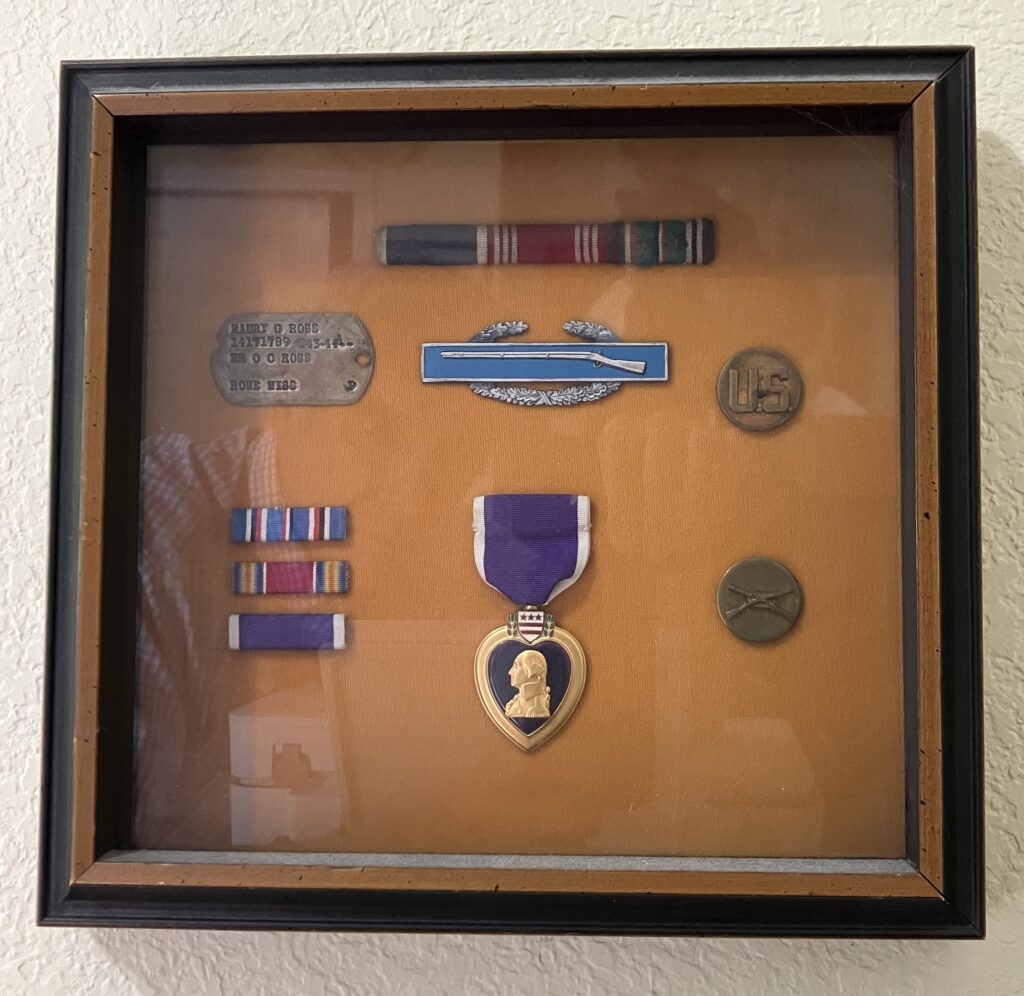
I’m pausing my research into USS Franklin to tell you a little about my father, who was a World War II veteran, seeing combat as a private first class in the U.S. Army’s 102nd “Ozark” Infantry Division. Dad grew up in Rome, MS, a very small farming town in the Mississippi Delta. He had a brother who was 11 years older than he. Their father was a farmer, former home builder, part-time deputy sheriff, and he and Dad’s mother ran a general store for many years.
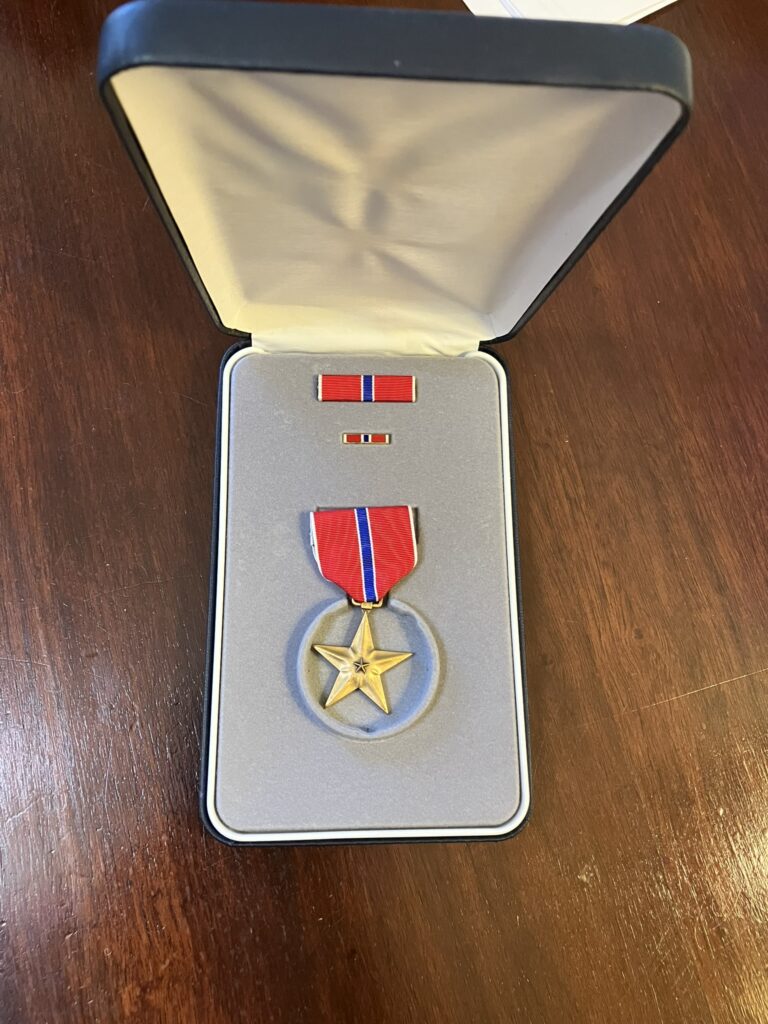
This oral history was made around 2007 when Dad was 84. He speaks slowly because he is remembering and wants to get it right. I had returned home to Atlanta, had podcasting software on my computer, and asked Dad if I could interview him about his wartime experiences. Other than telling a few funny stories, Dad never spoke about his Army life. Even in his oral history, he doesn’t go into detail about the fighting that earned him the Bronze Star.
He mentioned being wounded, but he omitted “the rest of the story,” where he had told my mother years before that he had lain in a cabbage patch for three hours before being rescued. Mom would say, “And he’s never eaten cabbage since!” Nor was it ever served at any meal in our home when my sister and I were growing up.
Dad would suffer PTSD for the rest of his life, most likely from the one combat incident he mentions. I’m pretty sure he omitted a great many details in this recounting.
Below is the transcript of the recording.
“I never dreamed, as a five-year-old starting kindergarten at school in Rome, Mississippi, of the significance looming on the horizon at Pearl Harbor. Before that, I finished grade school in Rome, and then went on to high school in Drew through the ninth through the twelfth grade. Times were tough then. We were in the midst of the Depression, cotton was selling for five cents a pound, and I did not know whether I would get a chance to go to college or not. My mother, who was a strong-willed, determined person, said, “If we have to sell some of the milk cows that we have, you are going to college.”
With that background, I went to Millsaps in 1940 as a freshman. College was quite a departure from high school in Drew, but it was fun, and I fit right in with a wonderful group of friends, who, in this year of 2007, I still maintain some contact with. The bombshell that exploded and changed my way of life was Pearl Harbor, which, as we all know, happened in December 1941.
December 7, 1941
Coming home from Millsaps to Rome to visit my parents meant one of two ways of transportation: you either hitchhiked or rode the Greyhound bus. On this day of Sunday, December 7th, 1941, I had hitchhiked home on a Friday and was catching the bus at the Eight Ball Service Station in Rome, which was the stop for the Greyhound bus, to go back to Millsaps. Just prior to going around to the bus station, news came on the radio that Pearl Harbor had been bombed. I got on the bus and people were completely stunned, wondering what their life was going to be like. I felt the same way, but only knew to go on back to school and try to continue doing what I had been doing.
There was a completely different attitude at school then, with people wondering, “Should I be getting into some sort of reserve? When will I be drafted? What happens to an eighteen-year-old college sophomore who didn’t weigh but 130 pounds at the time? Would he be accepted into… what branch of the military?” People were very apprehensive—scared would be a better word—about when and where they and our friends would be going.
Sometime during the early part of 1942, there had been several people from Millsaps who had volunteered and gone into either the Navy or the Army, and we got word back that one boy who had left early and was a rear gunner on one of the torpedo squadrons was shot down at sea. These things affected us very, very much, and school was important, but it was somewhat secondary. The social life went on, but on the top of every male’s mind was, “When do I have to go into the military?”
The military was offering everything from an officers’ training course starting at Millsaps to the Enlisted Reserve Corps, which you could join just by signing your name. Because the physical was so easy, I opted for the Enlisted Reserve Corps with about seven of my fraternity brothers, thinking, “Well, this is the way to stay out for a few more months,” realizing that we would be going in. We were really into this thing and would get together some afternoons and go out on a lonely dirt road and practice close-order drill. Of course, we thought you started off on your right foot at that time, so we weren’t really getting ourselves prepared for the military.
This was in late 1942, and in early 1943 we were called into the Army. We had no idea what to expect. All we knew was that we were being taken from the academic womb that we were living in and being sent to some foreign, strange place to do things that we had no idea what it was all about. The seven of us who had enrolled caught a bus in Jackson to Hattiesburg, which was the city outside of Camp Shelby, which was the induction center for the entire state of Mississippi. We had these orders that said we were to report to the Commanding General of Camp Shelby, Mississippi, for induction into the Army.
“You’re In The Army, Now!”
We got off the bus in Hattiesburg, had lunch at a fried chicken restaurant, thinking that the Army would never serve us fried chicken, and caught a military bus out to the gates of Camp Shelby. Since our orders called for us to report to the Commanding General of the base, we wandered around until we saw a nice white residence that had a little sign out front: “Home of the Commanding General.” This was what we were looking for. So I was delegated to go up and knock on the door of his residence, and an Army sergeant answered his front door. I said, “We have seven people here from Millsaps College ordered to report to the Commanding General. What are we supposed to do?”
He, in very strong words, informed me that we were not supposed to come to the Commanding General’s home, but to go to the Army recruits’ enlistees reception center. There we found out very quickly that we were in the Army and had no privilege towards the Commanding General. We went through the processing of tests and uniforms and all this on that day and were assigned to some temporary barracks. I shall never forget the first morning of hearing a sergeant rattle a baton in a garbage can, which was a wake-up call.
Well, I woke up and it was completely dark. In fact, it was 4 a.m. And my thoughts were, “What can you do at 4 a.m.? It’s still dark. They must have made a mistake somewhere.” But I found out later, 4 a.m. was the wake-up time. We were awakened and started a process that lasted about two weeks of tests, physical and mental, before being assigned to a basic training camp.
My brother Charles was a supply sergeant at Headquarters and Headquarters Company for the reception center and had been there for about a year and knew a lot of people in the Army reception center. Through his influence, I was sent to Camp Lee, Virginia, to the Quartermaster Corps, thinking this was a nice, safe place to spend the Army, not having any idea how long it would be or what. Basic training in the Quartermaster Corps was the same as basic training in the infantry, and those thirteen weeks were absolutely hell for an eighteen-year-old only two or three months removed from the academic world of Millsaps.
After basic training, the powers that be in the military decided that they needed a reserve manpower contingent with some military background to be used in the army of occupation of wherever, rather than being just cannon fodder. So I was assigned to what was called the ASTP, abbreviation for Army Specialized Training Program. To get in this, you had to pass an IQ test of such and such a score, have had two years of college, and some other criteria which aren’t important now; having finished basic training probably was one of them, yes
There were approximately 150,000 of these former college students that were sent to colleges all over the United States. Some of my friends went to VPI, LSU, Ohio State, and I was assigned briefly to Georgetown University in Washington, D.C., and then later went across town to Catholic University of America, where we were kept separate as a military unit from the students. We lived a regular college life in dormitories and took the regular college courses, except we were headed towards an engineering degree if we passed, rather than a liberal arts degree, which I had started working on before.
102nd “Ozark” Division at Camp Swift
This heaven on earth, in the military, lasted for about eight or nine months, and the war in Europe was not going along so well, and we were needing cannon fodder. Plus, Stalin was pushing for the second front in the invasion of Europe, and more infantrymen were needed than college boys studying chemistry and mathematics. The program was disbanded almost overnight, and 3,500 of us were sent to the 102nd Infantry Division at Camp Swift, Texas, which was located in the little town of Bastrop, right outside of Austin. The other 150 were scattered to the 84th Division in Camp Polk, Texas, and other divisions around all over the United States.
Here we were introduced to what was basic infantry military training. It was hard. It was scary. It was crawling under barbed wire with machine guns firing over your head. It was learning how to be an instrument, something that we had thought would never happen to us on that day in early 1943 when we knocked on the Commanding General’s residence at Camp Shelby, Mississippi. We trained and trained and trained. The division had been a training division, and what was there prior to the 3,500 were a lot of old Regular Army non-commissioned officers and a lot of ninety-day wonder second lieutenants. The word was to put us into a training position so that we could enter combat.
102nd “Ozark” Infantry Division Disembarks at Cherbourg
We trained for approximately nine months in the hot Texas heat, and my dates are elusive right now. But when we were deemed combat-ready, we were shipped to Camp Kilmer, New Jersey, and then from there on to the port of New York for transportation overseas. The invasion was in June 1944, and we left New York in July or August 1944. All of the troops that had invaded Europe had been based in England, but our division, the 102nd, which was composed of about 15,000-plus men, went directly to Cherbourg, France.
From there, we climbed down all the old rope ladders that you have seen on television, with a duffel bag and a rifle hanging off your back. We climbed down those rope ladders onto landing craft barges and then went into Cherbourg. As we were disembarking, there were German POWs taking our place on the landing craft, and they were whooping and hollering at us, “You going to war, we going to America.” That didn’t set too well. And if there had been ammunition in those rifles we were carrying, I’m afraid someone might have taken vengeance out on the POWs who were going back to America. [Dad cleaned up this story. In another version, when he wasn’t being recorded, he stated, “If I’d had ammunition and knew who said that, I’d have shot the sonofabitch!”]
There must have been a sadistic sailor somewhere on one of the six ships that we went over on, because as we were clambering down those landing nets, the ship’s loudspeaker system was playing “I’ll Be Home for Christmas.” I would like to have shot him also.
Question: “What day was this that you were climbing down the ladders?”
Answer: I have no idea. Days did not mean…
Question: “But was it somewhere around Christmas that time?”
Answer: No. Well, it was… it was in August to September.
Question: “Okay. So late summer, early fall.”
Answer: That’s right, of 1944.
[Note: The division arrived on 23 September 1944.]
We bivouacked in the foxholes outside of Cherbourg, in the area that had been fought over pretty heavily with the hedgerows. It rained all the time, and the pup tents would leak because, quite frankly, the Army wasn’t the best equipped in the world, as we had been propagandized in total. The one thing we did get introduced to—we were in the apple country of Normandy—and I’d never heard of apple brandy called Calvados, C-A-L-V-A-D-O-S. It’s about 110-proof apple brandy that will literally burn your throat to death, but being ready to go into combat, and with it raining all the time, Calvados was a brief respite.
We stayed there for equipment checks and whatever, and then were assigned to a French train that was still of the vintage of World War I, when the French trains were designed to carry forty men and forty mules or something like that. Anyway, we got on a train with fifty or seventy-five soldiers in a very, very small boxcar. We rode that thing for about a week up into northern Belgium, in the tip of Germany, outside of and close to what is now the city of Aachen. There was a new army being formed, the Ninth Army. It consisted of two British divisions, the 102nd and the 84th, which was the ASTP-supplied manpower group that had been in Fort Polk, Texas.
The 102nd “Ozark Infantry Division Reaches The Rhineland
Life started off in the foxholes. We were green troops but had good training and good discipline. We knew how to dig foxholes, but this was early fall. We would dig a foxhole and scrounge around for a few pieces of timber to put on top of them, and we were out in sugar beet fields and cabbage fields. We’d pile those sugar beets and cabbage on top of the few pieces of timber, throw a little dirt on top of that, and feel protected. Maybe we were protected from the German artillery, which they would lob a few shells from, even though we were five or ten miles off the front line, but it sure didn’t protect you from the rain. And the water would seep in right through the sugar beets.
We were in a defensive position until we finally got accustomed to life in the foxholes and what combat was really like. Our first taste of real combat was when the Germans decided that we were ready and the 102nd was going to move out into attack position; they laid down a real heavy, heavy artillery barrage. For some reason, a lot of us were caught out in the open. I remember lying down on the ground, holding onto my rifle and clawing a hole as deep as I could with my fingernails, which was about a half an inch—the hole, not my fingernails. The only prayer that I ever knew that I said was, “God, let me live,” and I would say that over and over.
Soon after that, we moved out and attacked various smaller German towns around the city of Gillenkirchen in the suburbs of Aachen, and got within sight of the Siegfried Line, with the concrete “teeth” that you’ve seen so much of, which were tank barriers. After about two months of this combat, in and out, in and out, and attacking towns, I don’t know what that little town was, but we went across a cabbage field under a lot of shelling. I remember a P-47 above us strafing the little town, and we got to the edge of it, which was kind of a wooded area.
As we were attacking, the word came down: “Drop your packs and fix bayonets.” That was probably the most frightening military order I’ve ever heard, because that meant there wasn’t any quarter being asked. Anyway, firing a rifle with the bayonet distorted all your sights, so I took the thing off and put it back, and we progressed on up to the edge of the town, taking a lot of small-arms fire. The German Army had two light machine guns to every squad. I was behind a log, and I saw a German soldier roll out of a foxhole with one of these light machine guns and set it up to start firing at us, us being about five or six GIs who were hugging that log.
As he rolled over, I remembered all the training I’d had in Texas. I put my sights on him and killed him. It was either him, with his machine gun firing at us, or shooting him. That was what we were there for. I had a sense of exhilaration by shooting that German soldier. But months later, and fifty years later, I still had that feeling not of exhilaration, but of, “Why did it have to happen? Was it the right thing to do?” And I just would hide my feelings. I still remember it as vividly as sitting here talking to my dear son, Glenn. But that had to happen.
We moved on into the town. When you attack a town, the Germans will always counterattack, so I had captured three German soldiers, and they counterattacked with mortar fire. One of those mortars fell very close to me, and I had made the Germans take their helmets off, and one of them was killed from that mortar fire, and I was wounded. I thought, “Let’s get the hell out of here.” So I took my two prisoners and went back towards the rear. I was wounded in the leg, and in the arm, and in the face a little bit.
I went back and dropped the prisoners off. I remember telling a lieutenant, or someone that I saw, “I’m going to get a bandage on my leg or arm, and I’ll be back.” Well, when I got to the aid station, they sent me back to the battalion aid station and then found out the wound was a little more serious than what I thought. I ended up in a general hospital after getting past the division aid station, hospital, division hospital, and then got to a hospital in Liège, Belgium.
Question: “Do you remember what month this was?”
Answer: November.
Question: “November of ’44?”
Answer: This was November of 1944.
The hospital in Liège was an old schoolhouse building, and the litters—everyone was on a litter—were just lined up and down the corridor. The unfortunate part about it was that this was at the time the Germans were trying to blow Liège off the face of the earth with the buzz bombs. So we were in as much danger there in the hospital, with the buzz bombs coming over, almost as if we were back on the front line. But I promise you, I would much rather have been in that hospital on a stretcher than in a foxhole on the front line.
I was operated on there; they removed the shrapnel from my arm and face and decided to leave it in my leg, where it is still there, and I was evacuated by C-47 to England. They strapped the litters in the C-47 up against the wall, and probably about twenty soldiers would be in a C-47.
Question: “And a C-47 is the military version of a DC-3 cargo plane.”
Answer: That’s right. We got back to England and were sent to a British naval hospital. You have to understand the British and the British Navy and their traditions: we had white sheets, white blankets, and Brussels sprouts for breakfast.
Question: “And do you like Brussels sprouts?”
Answer: To this day, I’ve never liked Brussels sprouts. But I have never seen such attentive people—nurses, hospital personnel—in all my life as were in that British hospital, where I stayed for two or three weeks. This was still in November of 1944, and I was in that hospital for two or three weeks and then was sent to an American general hospital. I stayed in that general hospital for three months, due to the fact that the shrapnel in my leg was about to cut this tendon, and I had to have a cast on it and could only hobble around.
After that recuperation period, I was given limited service, which was a classification LS versus GS, general service, because if I’d been given general service, I could very well have been sent back to the infantry as a replacement to one of the infantry divisions. But anyway, the LS service category classification got me sent to a replacement depot. At that time, they needed some administrative people in the Air Force, and they asked me, “Could you type?” I had typing in high school, and I could do a little hunt-and-peck. But I sure worked hard for about two or three weeks to hone my typing skills, because that typewriter was a long way from an M1 rifle.
“You’re In the Army Air Force Now!”
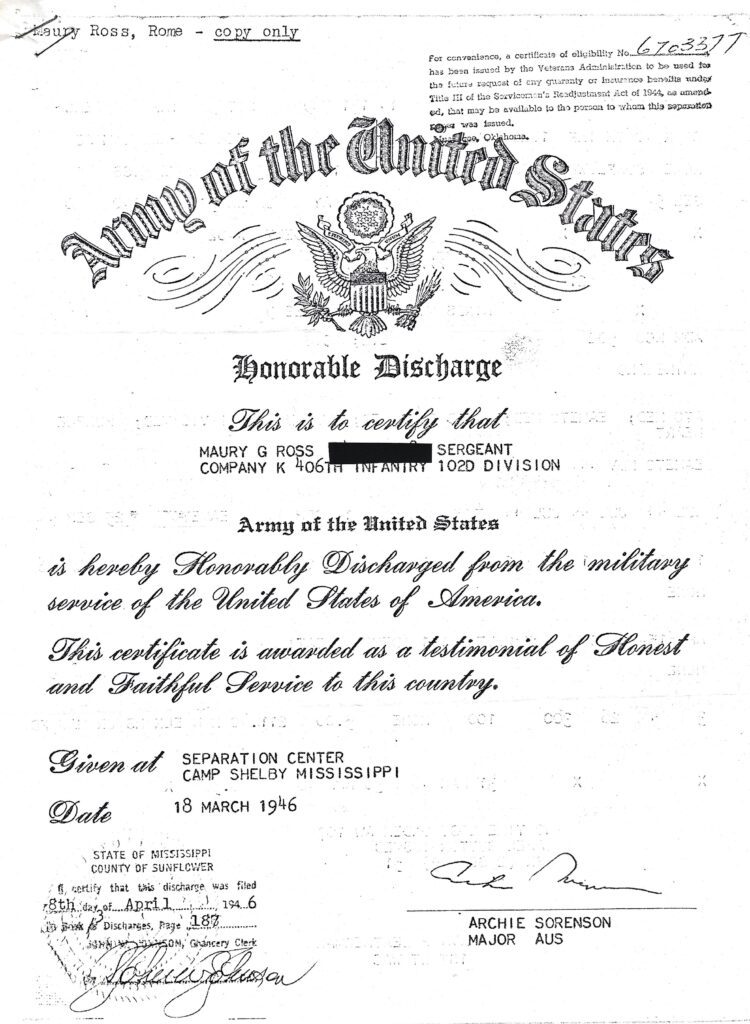
So I got transferred to the Air Force and was sent to London in an administrative pool. I was looked upon and interviewed for a job as an administrative clerk for the air surgeon’s office of the Air Force. I got that job and started off with them, with a captain from Wichita Falls, Texas, who was my immediate boss. He and I became somewhat friends. He wasn’t too chummy with enlisted men, but he was a nice guy, a psychiatrist, by the way, and I stayed with him from London to Paris to Wiesbaden, Germany. He went from captain to lieutenant colonel, and I went from PFC to sergeant, so I rank it was a pretty good swap-off. It was a good assignment, because all the people you dealt with were doctors first and military second. I finished up twenty months in Europe in the air surgeon’s office, and then came back home in March of 1946.
Question: “Hold on. My computer locked up.”
Answer: “I think that’s it.”
Question: “Well, go back and do like the last 30 seconds, where you… he got promoted to colonel and you got promoted to sergeant, because what happened was my computer’s timed to lock up every 10 minutes if there’s no…”
Answer: My immediate boss was a captain who was a doctor, and he and I became somewhat friends, even though he was not real chummy with enlisted men. But he was a nice fella, and I stayed with him from London to Paris, as we moved the office, to Wiesbaden. During that time, he was promoted from captain to major to lieutenant colonel, and I went from PFC to corporal to sergeant, so I rank it was a good swap-off. I stayed in Europe a total of twenty months, and when my points were enough to get me back home, I departed Europe in March 1946, and a month later, I was back in Mississippi.
###
Did you arrive here via a search engine? I am the author of the forthcoming book Heroes By The Hundreds: The Story of the USS Franklin (CV-13). In addition to writing about the bravery of her crew, I will discuss the lessons we can learn in leadership and decision-making.
Join others who are interested in keeping up with my research by subscribing to my monthly newsletter, Glenn’s Action Report. You can sign up for it below. Feel free to leave a comment or ask a question.
You can also follow me on Facebook. There, I am M. Glenn Ross, Author.
On Instagram and Threads, I’m @mglennross
On LinkedIn, I’m txglennross.
Feel free to leave a comment or ask a question. Thanks for reading.
-Glenn