Admiral William Halsey Displeased With USS Franklin’s Readiness
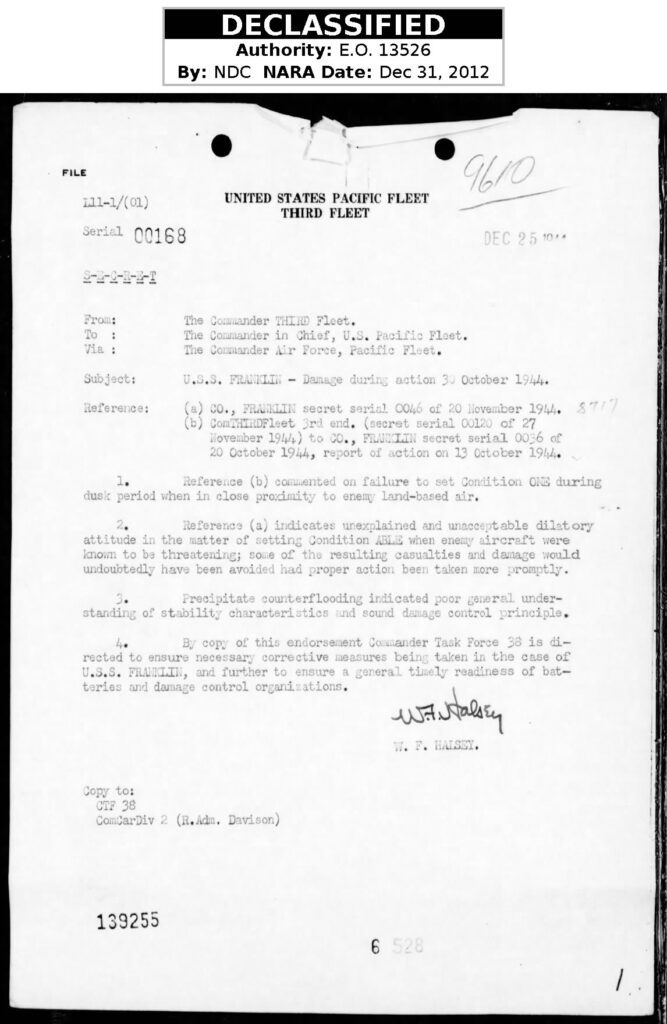
Admiral William Halsey, commander of Third Fleet, was displeased. In a November 20, 1944, report, War Damage to U.S.S. Franklin (CV13) during action with enemy aircraft 30 October 1944, Captain Leslie Gheres described Franklin’s damage, which drew sharp criticism from Admiral Halsey.
(Captain Gehres had assumed command on 7 November 1944, succeeding Captain James Shoemaker, who was in charge on 30 October and had led since the ship’s commissioning in January. Gehres was not involved in the 30 October attack.)
The Admiral’s remarks, dated December 25, 1944, emphatically made the point that lapses in readiness directly endangered the ship and crew. He wrote:
2. Reference (a) indicates unexplained and unacceptable dilatory attitude in the matter of setting Condition ABLE when enemy aircraft were known to be threatening; some of the resulting casualties and damage would have undoubtedly have been avoided had proper action been taken more promptly.
In the US Navy, “readiness” covers crew response and ship preparedness. It is crucial to preventing loss in the face of enemy threats—and remains so today. Condition Readiness ONE means General Quarters, the highest state of crew alertness under threat or attack.
Material Conditions describe how a ship’s crew preserves watertight integrity. Condition ABLE, referenced in the Admiral’s remarks, was the strictest, allowing fewer hatches to be opened and thus maximizing watertight integrity.
Admiral William Halsey: Lack of Readiness Could Cost Lives
Admiral Halsey’s concern was warranted. USS Franklin operated in dangerous waters near the Philippines, with little warning of enemy air attacks. Rigorous adherence to readiness was essential. Failure risked preventable casualties and damage. Halsey’s frustration stemmed from recent losses of both men and ships.
In October 1944, USS Franklin (CV-13) served in Task Force 38, led by Admiral Marc Mitscher and part of Halsey’s Third Fleet. Their mission: provide air support to General Douglas MacArthur’s army in the Philippine invasion. Franklin’s group, with four carriers and escorts, was 100 miles off the island of Samar.
The Kamikaze Attack on 30 October
On 30 October, her task group was attacked. Gehres’ report states:
- That morning, the ship was at Material Condition BAKER, less restrictive than ABLE—meaning fewer watertight doors were closed.
- At 1410, radar detected bogies—unidentified aircraft—37 miles out.
- At 1412, Torpedo Defense was sounded, and all anti-aircraft batteries were manned.
- At 1419 General Quarters was sounded.
- At about 1423, Material Condition ABLE was set. (A separate document, USS Franklin CV-13 War Damage Report, states that“Procedure in Franklin required separate orders for General Quarters and Condition ABLE, presumably to allow battle stations to be manned prior to closing up the ship.”)
- At 1426, Japanese suicide bombers attacked.
Attacked by three bombers, USS Franklin was struck by a kamikaze, resulting in 56 deaths. Admiral Halsey was displeased because the ship was only partway through setting Material Condition ABLE. Not having the right hatches closed may have resulted in additional casualties and damage.
A second kamikaze flew over the ship strking the light carrier USS Belleau Wood.
After the attack, the ship returned to Ulithi Anchorage. Shoemaker rotated to shore command, as planned before the attack. Admiral Mitscher would also be replaced by Admiral John McCain as Task Force 38 commander.
Crew Fatigue May Have Influenced Captain Shoemaker
I do not think Admiral Halsey wanted to punish Shoemaker. He wanted Admiral McCain and Third Fleet captains to enforce readiness under threat. His primary concern was future compliance.
For context, Halsey had already requested that Task Force 38 be relieved due to crew fatigue, but Nimitz denied it. Seasonal rains kept airfields unusable, delaying the arrival of Army Air Forces fighters and bombers to assume ground support roles.
The average Philippine air temperature in October is in the 80s, making temperatures rise above 90 degrees on sunny afternoons. Only pilot ready rooms and CICs had air conditioning. Closing watertight doors for higher readiness cuts off airflow, making spaces uncomfortable and contributing to fatigue. At one point, half of Franklin’s crew went to sickbay with heat rash. Crew fatigue may have affected Shoemaker’s choice.
Shoemaker received the Silver Star for commanding Franklin during the October 25 action, when Halsey led Third Fleet against the Japanese at Cape Engaño. He had earned a previous Legion of Merit and a second after Franklin, for organizing a new naval aviation base under tough circumstances. He was promoted to Rear Admiral before retiring.
Gehres’ Decision Also Questioned
If you are unfamiliar with the 19 March 1945 attack on Franklin and other Task Force 58 ships, here is a brief summary. A Japanese bomber evaded air defense and dropped two bombs onto the Essex-class carrier. Task Force 58, about 100 ships including 16 carriers, aimed to reduce the Japanese naval and air forces before the Okinawa invasion.
Over the next 11 hours, Franklin fought for survival. More than eight hundred crew members died, while hundreds performed heroically. The crew became, and remains, the most decorated in US Navy history.
The March 1945 attack raised questions about the captain’s decision to avoid General Quarters. Franklin’s crew and their families wanted to know why Captain Gehres didn’t sound General Quarters before the attack—and many still do.
Anderson Clark, who is producing a documentary on USS Franklin, published two articles in the U.S. Naval Institute’s Proceedings Magazine that examined this topic in depth (Part 1, Part 2). I highly recommend reading them. He goes into great depth on readiness, not only in Franklin but also across the rest of her task group.
Different stories explain Captain Gehres’ readiness decisions. Franklin had been at General Quarters multiple times during the night of 18-19 March, leaving the crew sleep-deprived. Gehres may have relaxed readiness due to this fatigue, as Shoemaker might have months earlier.
Admiral William Halsey was right in pointing out the delay in coming to Material Condition ABLE. We don’t know for certain whether Captains Shoemaker and Gehres delayed setting the appropriate conditions out of concern for their crews; to me, if they did, this is worthy of discussion among those interested in leadership. What would you have done?
Did you arrive here via a search engine? I am the author of the forthcoming book Heroes By The Hundreds: The Story of the USS Franklin (CV-13). In addition to writing about the bravery of her crew, I will discuss the lessons we can learn in leadership and decision-making.
Join others who are interested in keeping up with my research by subscribing to my monthly newsletter, Glenn’s Action Report. You can sign up for it below. Feel free to leave a comment or ask a question.
You can also follow me on Facebook. There, I am M. Glenn Ross, Author.
On Instagram and Threads, I’m @mglennross
On LinkedIn, I’m txglennross.
Feel free to leave a comment or ask a question. Thanks for reading.
-Glenn
