Kamikazes “Body Crash” USS Franklin and USS Belleau Wood
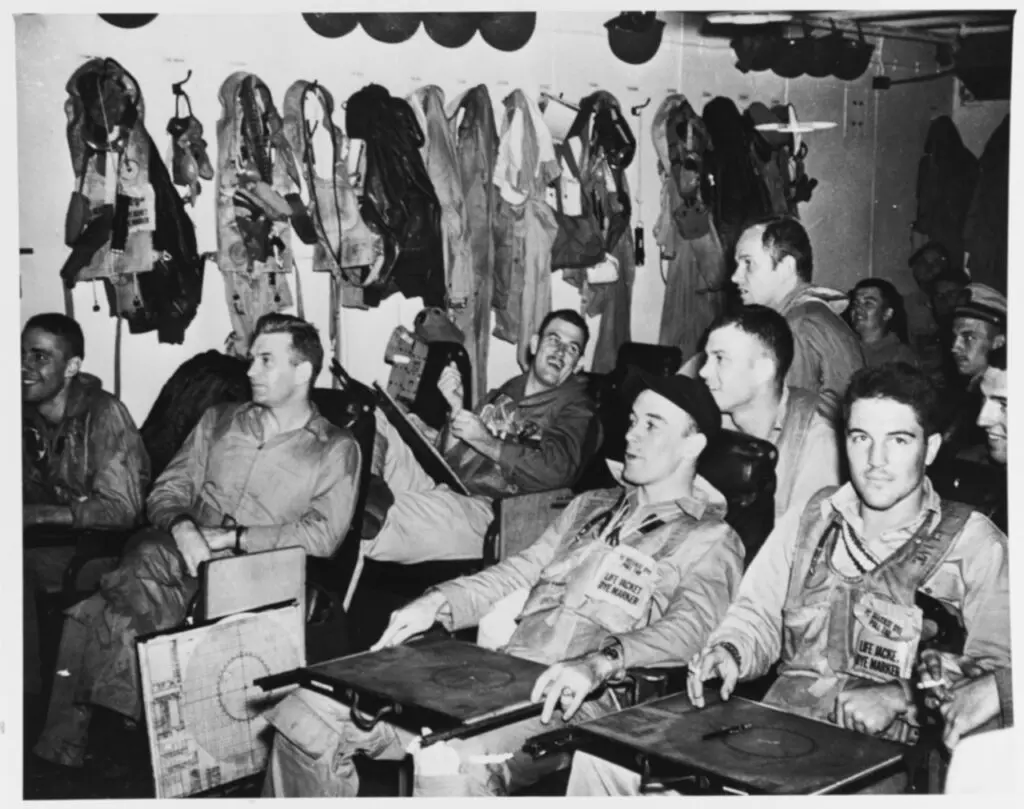
How difficult was it to identify Japanese kamikazes? Fire Controlman 1st Class Karl Braddick gives us his account below. And Seaman 1st Class Walt Gallagher shares his perspective in a separate blog post I wrote several years ago, “Kamikazes Attack USS Franklin CV-13.“
On 30 October 1944, Admiral Halsey’s Third Fleet continued to support the invasion of the Philippines. Task Group 38.4, headed by Admiral Ralph Davison, was one of four task groups that made up Task Force 38, the naval air arm of the Third Fleet. Aircraft carriers making up Admiral Davison’s task group were the venerable USS Enterprise (CV-6), USS Franklin (CV-13), USS Belleau Wood (CVL-24), and USS San Jacinto (CVL-30). Two cruisers and eleven destroyers protected them.
This was just five days after the first kamikazes attacked Navy ships. In the attack, sources differ as to the number of attackers, as you can see in the accounts below.*
In his 2005 oral history, Karl Braddick recounts the attack.**
…but the Franklin was the first ship attacked [in the task group that day] by kamikazes. There were three of them coming in, in the same pattern as our own landing. So you can appreciate it would be hard to identify whether it was Jap[anese] or ours. They were spotted and our guns started shooting at them; well we were maneuvering to shoot and one of them caught us right in the middle. One of the planes was trying to hit us too and went over the side right where my mount was, where my director was. The third one saw that he was going to miss and pulled up and hit the USS Belleau Wood in front of us; so three planes got two carriers. There was a lot of loss there.1
Kamikazes Attack USS Franklin
Admiral Davison’s Action Report for 22-30 October 1944 states:
At 1425, the suicide diving bombing attack on carriers and this group was underway. Failure of the combat air patrol to intercept the bogeys is probably due to the fast, gliding approach from 18,000 feet altitude, commencing 40 miles distant. With excellent visibility it is believed that the enemy planes spotted the group at this distance. Radar plot showed bogey and combat air patrol merged at 265° T, 40 miles. The combat air patrol did not sight the bogey due to altitude differences. The two divisions scrambled by Belleau Wood and the three division scrambled by Enterprise, while directed to the bogey’s position, were not able to establish visual contact. One division of combat air patrol intercepted another raid reported at 1404 bearing 260° T, distance 60 miles, destroyed four ZEKES and turned away the remaining one. The third raid reported at 1416 did not materialize.
Five enemy planes in all made the attack on the carriers. Reports as to the type of these planes differ, but it is believed that ZEKES and at least one JUDY attacked. Task group 38.4, in formation 5-VD was swinging to the left to course 090 degrees T, speed 24 knots, when the enemy planes initiated a dive of approximately 75° out of the sun from 2000 feet. Two enemy planes diving on the San Jacinto were shot down as was one over the Enterprise. Of the other two planes, one crashed the Franklin just abaft the island structure, and the other crashed on the after portion of the flight deck of the Belleau Wood, after dropping a bomb which was a near miss off the starboard beam of the Franklin.2
Fifty-six men were killed in the kamikaze attack aboard Franklin. The initial kamikaze strike killed about 20. The rest died from secondary explosions as they attempted to fight fires and rescue shipmates in the first hour after the attack.
USS Belleau Wood Attacked

Ninety-two were killed aboard Belleau Wood when the kamikaze slammed into eleven fully loaded aircraft parked on the aft flight deck, igniting massive fires and explosions that took three hours to bring under control.3
Both carriers would have to return to the U.S. mainland for repairs. They would not see action again until March 1945.
Burial at Sea
The fifty-six men killed aboard Franklin would be buried at sea in two separate ceremonies. This blog post, Burials At Sea By USS Franklin 1944, lists the names of the men buried in each ceremony and the locations where the burials occurred.
*The Japanese did not refer to their pilots and others who died in kamikaze attacks as committing suicide. They referred to it as “body-crashing.”
**Karl Braddick’s oral history was recorded and later transcribed. His oral history was transcribed exactly as he spoke. Please ignore any grammatical errors.
Did you arrive here via a search engine? I am the author of the forthcoming book Heroes By The Hundreds: The Story of the USS Franklin (CV-13). In addition to writing about the bravery of her crew, I will discuss the lessons we can learn in leadership and decision-making.
Join others who are interested in keeping up with my research by subscribing to my monthly newsletter, Glenn’s Action Report. You can sign up for it below. Feel free to leave a comment or ask a question.
You can also follow me on Facebook. There, I am M. Glenn Ross, Author.
On Instagram and Threads, I’m @mglennross
On LinkedIn, I’m txglennross.
Feel free to leave a comment or ask a question. Thanks for reading.
-Glenn
Footnotes
- Braddick, Karl, An Interview with Karl Braddick, Interview by Richard Misenhimer, November 29, 2005, Museum of the Pacific War
- Commander, Task Group Thirty-eight Point Four, Commander Carrier Division Two, Action Report Operations Against Philippines and Japanese Imperial Fleet 22 Through 30 October 1944, 12
- Naval History and Heritage Command, USS Belleau Wood CVL-24, https://www.history.navy.mil/browse-by-topic/ships/aircraft-carriers/uss-belleau-wood.html, Accessed 30 October 2025
