Remembering Lt. Milton Ricketts at the Battle of Coral Sea
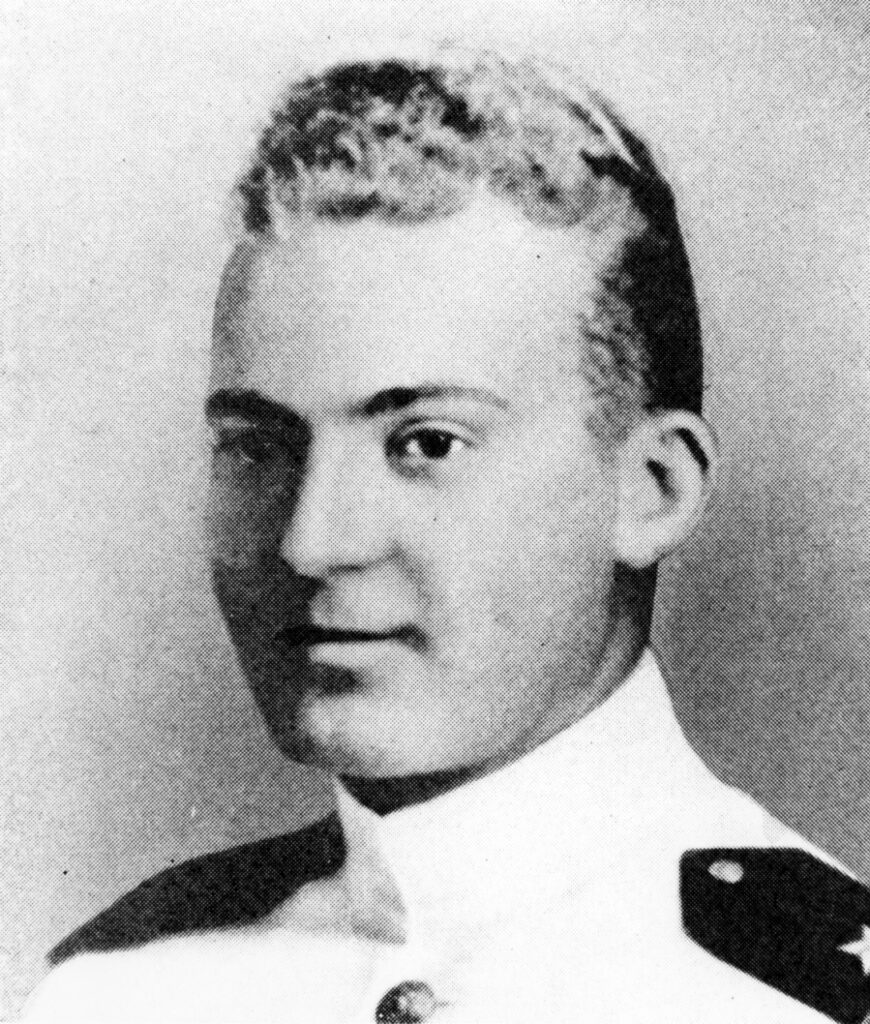
One of the many reasons I love studying history is learning about the solitary actions of individual men that have a major impact on the course of events. Remember the proverb that begins “For want of a nail…?” In the proverb’s story, a kingdom was lost. But there are plenty of examples of kingdoms, or at least battles, being won, as well.
In the United States, it’s Memorial Day weekend. Because of the confluence of the anniversaries of the Battle of the Coral Sea (May 4-8, 1942) Memorial Day 2026, and the Battle of Midway (June 4-7, 1942) let me tell you the story of one’s man’s heroic actions at the Battle of the Coral Sea that may well have helped the US Navy win at the Battle of Midway a month later.
I came across his story while researching damage control and ship survivability for my book on the World War II Essex-class carrier, USS Franklin (CV-13). “Big Ben,” as her crew nicknamed her, twice suffered damage that knocked her out of the Pacific war, once in October 1944 and again in March 1945. Both times, the heroic actions of her crew trained in damage control saved many lives and allowed the ship to return under her own power to the US mainland for repairs. Franklin’s crew benefited from lessons learned in earlier battles, and the actions they took when she was damaged would also influence how the Navy approached damage control and ship design.
Let’s go back to the Battle of Coral Sea. At that point in the war, US naval doctrine called for each carrier to be in its own task force. Task Force 11 centered around USS Lexington (CV-2) and Task Force 17 centered around USS Yorktown (CV-5).
On the final day of the battle, 8 May 1942, the two carriers came under attack by Japanese naval aviators who sank Lexington. Yorktown survived several near misses, including one that lifted her propellers out of the water. She took one bomb hit 15 feet from the ship’s island, piercing three decks before exploding. It killed 37 men outright and wounded many others. Ultimately, 66 men would die.
Lieutenant Milton Ricketts Sacrifices His Life
One of those mortally wounded in the explosion was Lieutenant Milton Ernest Ricketts, USN. He was a native of Baltimore, Maryland, and graduated from the US Naval Academy in 1935. His first ship was the USS Ranger (CV-4).1
For his actions that day, he would posthumously receive the Medal of Honor. His citation tells the story better than I can:
For extraordinary and distinguished gallantry above and beyond the call of duty as officer-in-charge of the Engineering Repair Party of the U.S.S. Yorktown in action against enemy Japanese forces in the Battle of the Coral Sea on 8 May 1942. During the severe bombing of the Yorktown by enemy Japanese forces, an aerial bomb passed through and exploded directly beneath the compartment in which Lt. Ricketts’ battle station was located, killing, wounding, or stunning all of his men and mortally wounding him. Despite his ebbing strength, Lt. Ricketts promptly opened the valve of a near-by fireplug, partially led out the firehose, and directed a heavy stream of water into the fire before dropping dead beside the hose. His courageous action, which undoubtedly prevented the rapid spread of fire to serious proportions, and his unflinching devotion to duty were in keeping with the highest traditions of the U.S. Naval Service. He gallantly gave his life for his country.2
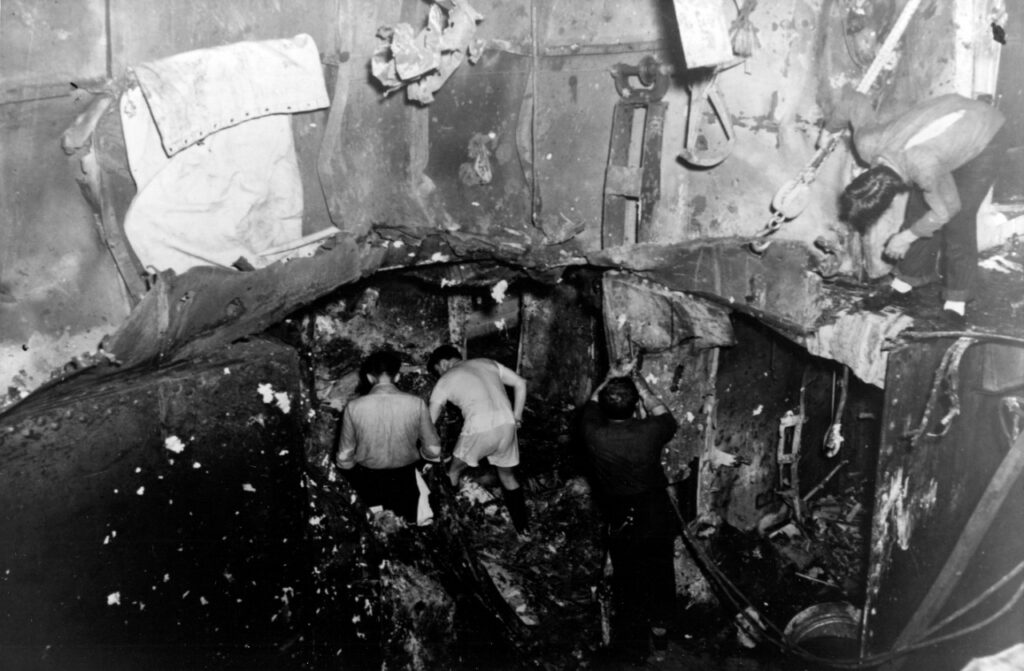
Ricketts’ actions, along with those of many other crew members, prevented much more serious damage.3
Damage Control Efforts Allow Yorktown to Fight at Midway
The heroic efforts of all involved in damage control on the ship that day most likely preserved Yorktown’s ability to participate in the Battle of Midway the following month. And her air group would play a key role in the destruction of the Japanese carrier force, Kido Butai.4
It was Yorktown fliers who sank the IJN Soryu and participated in the sinking of IJN Hiryu. Had she not been there, Midway might not have been the strategic victory it was. In fact, with Soryu still in fighting trim, her aviators might have inflicted considerable damage on the American task forces. There might not have been a victory.
In the Naval History and Heritage Command’s publication, Case Studies in Damage Control, edited by Jon S. Middaugh and Tyler A. Pitrof, Middaugh writes:
Damage control aims to keep a ship afloat and ready to fight, either in the current engagement or in a future one after the vessel has been sufficiently repaired.5
Note that last phrase about future engagements.
As I research my book, I continually come across examples of how one man’s actions may have had a major impact, sometimes immediately, sometimes at a later date. In this case, Ricketts and his fellow crew members, who contained the damage to Yorktown, allowed her to participate in the Battle of Midway. Admiral Nimitz would have most likely still sought battle at Midway without Yorktown.6 Were it not for the efforts of Ricketts and his shipmates, Midway might not have been the decisive victory we know it as.
On this Memorial Day 2026, I honor Lieutenant Milton E. Ricketts, USN, and those who gave their lives fighting to save their ships.
Did you arrive here via a search engine? I am the author of the forthcoming book Heroes By The Hundreds: The Story of the USS Franklin (CV-13). I am writing this book to help readers of World War II history discover the extraordinary accomplishments of the USS Franklin crew, so the crew’s story receives the recognition it deserves, and readers gain insight into leadership decisions made under pressure.
Join others who are interested in keeping up with my research by subscribing to my monthly newsletter, Glenn’s Action Report. You can sign up for it below. Feel free to leave a comment or ask a question.
You can also follow me on Facebook. There, I am M. Glenn Ross, Author.
On Instagram and Threads, I’m @mglennross
On LinkedIn, I’m txglennross.
Feel free to leave a comment or ask a question. Thanks for reading.
-Glenn
Footnotes
- Ricketts, Milton Ernest, Lieutenant, USN, (1913-1942)https://www.history.navy.mil/our-collections/photography/us-people/r/ricketts-milton-ernest.html Accessed 23 May 2026
- Congressional Medal of Honor Society, Milton Ernest Ricketts, https://www.cmohs.org/recipients/milton-e-ricketts Accessed 23 May 2026
- Case Studies In Damage Control, ed. by Jon S. Middaugh and Tyler A. Pitrof (Washington, DC: Naval History and Heritage Command, 2025), 1
- Parshall, Jonathan, and Tully, Anthony, “Shattered Sword: The Untold Story of the Battle of Midway (Lincoln: 2005) 217, Symonds, Craig L. The Battle of Midway (Oxford University Press: New York, 2011) 305-308
- Middaugh, Jon S., and Tyler A. Pitrof, eds. Case Studies in Damage Control. Contributions to Naval History, no. 13. Washington, DC: Naval History and Heritage Command, Department of the Navy, 2025, 1
- Parshall, Tully, Shattered Sword, 94
