Stories From The USS Franklin: Caught Between The Devil And The Deep Blue Sea
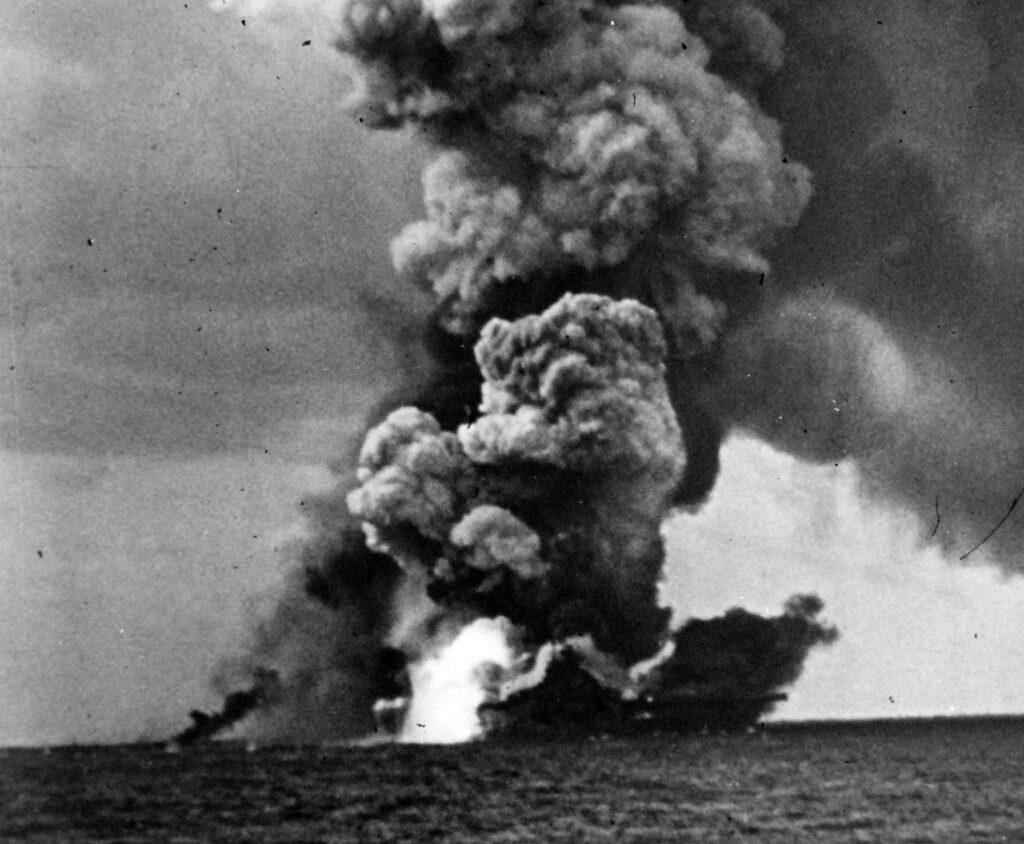
Last week, I came across a radio interview conducted in June 1945 featuring two stories from the USS Franklin. These stories occurred during the 19 March 1945 attack on Big Ben, as her crew nicknamed her. On May 18th, the US Navy had just released to the American public the news that Franklin, an Essex-class carrier, had been severely damaged by an attack from a Japanese bomber two months earlier. The Navy would eventually list 807 men as dying that day. That number killed in action aboard Franklin ranks third behind USS Arizona, which lost 1117 men during the attack on Pearl Harbor, 7 December 1945, and USS Indianapolis, which lost 880 men when sunk on 30 July 1945.
Franklin remains the most heavily damaged US carrier not to have sunk.
The interview I came across aired in June 1945 on WTIC, a radio station in Hartford, Connecticut. Two of the ship’s crew, Torpedoman 1/c Alfred E. Amos from Hartford, and Gunner’s Mate 3/c Stanley J. Olander from Manchester, Connecticut, had met each other for the first time when they sat next to each other on a bus taking them to the Franklin. They were on the ship when it was commissioned.
On the morning of 19 March 1945, Franklin, along with 15 other carriers and dozens of other battleships, cruisers, and destroyers, composed Task Force 58. Their mission, codenamed Operation Lucky Day, was to destroy as many Japanese military assets as possible to deny their use during the upcoming invasion of Okinawa, less than two weeks away.
A few minutes after 0700 local time, a lone bomber managed to penetrate the task force’s defenses, dropping two 550-lb bombs onto Franklin. It would take nearly 11 hours to extinguish the fires and halt the explosions. When the first explosions rang out, Alfred Amos was at his battle station below decks. His job involved servicing aerial torpedoes and the new Tiny Tim rockets. 1 He heard a loud explosion, then smoke began pouring out of the vents. He and others with him evacuated to the fantail at the rear of the ship. The following is a transcript from the radio interview. [My annotations are in these brackets.]
Interview Transcript
Al: On the morning of March 19th, we were taking cat naps in the shop. It was cooler there than in our sleeping compartments. [In another oral history, Al states that he had earlier gone to breakfast and a chief petty officer had jumped him to the head of the line, knowing that he needed to return to his battle station to ready torpedoes and rockets. He went on to state that, had he not finished breakfast and returned to his battle station, he would have probably died in the initial explosions.] Suddenly, we heard a large explosion. Smoke poured down the ventilator system, so we had to leave. We immediately picked up our life jackets and started forward. But we had to turn around and go back. We dogged down the hatch and started aft. Then a [unintelligible] blew the lights out. We made our way aft as far as possible to the fantail. There were so many people there, we couldn’t move. Flames were roaring all around us; smoke was choking us. There wasn’t nothing left to do—[unintelligible]
Announcer: How long were you in the water?
Al: Well, Bob, I really don’t remember much about all that time in the water, ‘cept that it was cold. I was told later that it was four hours. I swam to a group. It was certainly lucky that I had my life jacket on ’cause we didn’t have any raft and I was in no state to keep afloat under my own power. [Also, Amos did not know how to swim.] The next thing I remember is coming to in a bunk. I had been picked up by a destroyer. The men on that destroyer certainly treated us swell. They took us to the Carolines [the US Navy anchorage at Ulithi]. That’s where I finally learned Stan’s last name.
Announcer: Oh, you decided it was time to be a little more specific about names after that experience, huh? Well, tell me, did you wait for the Franklin there in the Carolines?
Al: Yes, the Franklin picked us up there, and we spent the rest of the trip back to the Brooklyn Navy Yard cleaning up the debris. [Amos was a torpedoeman and was deemed “essential personnel” as he might be needed to defuse any armed torpedoes or rockets. Olander was not deemed essential so he was not allowed to be returned.]
Announcer: And there was plenty of debris to clean up, I imagine.
Well, uh, what about you, Stan? Where were you when the explosions hit?
Stan: We were at mess. We heard two terrific explosions. I tried to get to my battle station on deck but it was a roaring furnace. I tried to open a hatch cover, but I was met by a blast of flames. We tried to get topside another way, but flames and smoke drove us back. After about 15 minutes, we were able to get aft on the fantail.
There was about 40 of us and we were isolated. We didn’t know what to do. We didn’t want to leave our ship, ’cause we couldn’t get to our stations, and we were no good to anyone where we were. There was ammunition all around the rail where we were standing, and we figured there might be another explosion any minute. We figured right too, because right then a blast knocked me down. I lost my baseball cap. You know, we all wear those to keep the sun out of our eyes.
Announcer: You were worried about your baseball cap, were you?
Yes, it’s funny, but I remember looking for my cap. And then I looked for the other men again, but they had all disappeared. Well, I decided I better leave and fast! I took a flying leap over the ammunition into the water 25 feet below. It knocked the wind out of me, but the cold water soon brought me to. I started to swim. I had a jacket on-not a life jacket, but a regular one-and it was heavy. So I got that off. I tried to get my shoes off, but I couldn’t. After a while, I saw a raft, and oh boy, was I glad to see it!
Announcer: I bet that was a wonderful sight! I presume you climbed aboard.
Stan: Yes, Bob, and I was the first one on it. Soon it was full, and some men were clinging to the sides, but others never did reach it.
Announcer: And what happened then, Stan?
Stan: Well, luckily for us, the Franklin kept moving away. She was out of control by then. It was two hours before we were able to attract the attention of a destroyer. She took us aboard, took off our wet, cold clothes, and wrapped us in warm Navy blankets. Gave us hot drinks, put us to bed. That destroyer picked up 400 survivors. We stopped in the Carolines and a transport took us to Pearl Harbor.
Announcer: Then you didn’t come back on the Franklin?
Stan: No, but I went aboard once she stopped on her way back to the States. I wanted to see what, if anything, I could find of my personal belongings.
Announcer: And, uh, did you find anything?
Stan: Yes, I found some clothes and, believe it or not, I found my billfold with $20 still in it. So you see, I was lucky after all.
Announcer: Boy, you certainly were, Stan.
Stan: Of course, as you know, a lot of the boys weren’t as lucky as Amos and I.
Announcer: Well, that’s true. Unfortunately, true.2
Both men were forced to jump off the ship’s fantail. They were quite factual about the experience, but because the war was still on, they downplayed the danger involved. Every account I have read about the fantail states that the men were truly trapped between the Devil-dying by flame or explosion on the fantail-or jumping into the deep blue sea and hoping they would be rescued.
Each sailor was then asked about their plans after their leave ended. Stan responded that he was going to advanced gunnery school in San Diego. Alfred said that he had asked to return to the Franklin.
Did you arrive here via a search engine? I am the author of the forthcoming book Heroes By The Hundreds: The Story of the USS Franklin (CV-13). In addition to writing about the bravery of the crews that saved her, I will discuss the lessons we can learn from leadership and decision-making, as well as the changes the US Navy made in response to those lessons.
Feel free to follow me on Facebook. There, I am M. Glenn Ross, Author. I also write a monthly newsletter, Glenn’s Action Report, about subjects I find interesting in my research. You can sign up for it below to read more stories about USS Franklin. Feel free to leave a comment or ask a question. Thanks for reading.
-Glenn
Footnotes
- Nilo, James R. and St. Peters, Robert, Editors, USS Franklin (CV-13) The Ship That Wouldn’t Die (Paducah, KY: Turner Publishing Company, 1996) 48
- Amos, Alfred and Olander, Stanley. News 4506xx USS Franklin Survivors: Alfred Amos Hartford. WTIC Radio Interview, June 1945. otr.com, accessed September 18, 2025, subscription required.
